

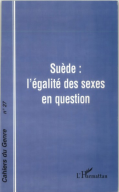
The swedish white book The White Paper Investigating Feminism in Sweden is the result of a symposium held at the Swedish Cultural Centre in Paris bringing together researchers in the gender equality and was funded by the Swedish Embassy in Paris. The White Paper presents various reports by specialists and researchers on gender equality and inequality in Sweden and aims to be a new alternative, a new strategy and advocates for gender equality.
Its main conclusions are :
In 1994, in Sweden, a woman’s income was ~68% of that of a man. Today, a woman’s hour wage is 80% of that of a man. Employment rate is the same for men and women (70%) Women are increasingly taking part in political and economic decision-making: 42% of Swedish private companies have at least one woman on their management board
Sweden government gave 365 days of parental leave at birth to be shared between the parents. Seventy per cent of mothers take this leave and take an average of 85 per cent of the days granted. For housework, the study found that the one in the couple who had to do the most was the one who earned the least money. The more money the wife earns, the more she is able to impose conditions on her husband. However, the unequal division of labour is, according to the study, one of the main causes of divorce in Sweden. The paper, being a White Paper, has a political significance: The head of the study was a political scientist but, faced with protests from feminists and feminist associations, he was replaced by a former Social Democratic MP and former economist, Kristina Personn.
Researchers participating in the study and colloquium preparing this White Paper were equally selected, with due regard for gender parity.
Contrary to expectations, the White Paper did not lead to reform despite its proposals:
Create an organisation that would inform companies on the wage evaluation to achieve equality. Improve legislation to oblige companies to disclose employees' salaries to the Ombudsman and improve the fight against discrimination, make gender equality education obligated in schools.
who expected the White Paper to propose a reform with big ideas to finally make Sweden a country even closer to full equality between men and women, although Sweden is a European champion, with its Nordic neighbours, and a world champion in this field.
The problems of the White Paper also come from the fact that the two main politicians at its origin left the project due to their electoral failure and/or judicial problem: Beng Westerberg from its inception in 1994, after he failed in the elections, which suggests he was using feminism for personal gain, to get elected, and Mona Sahlin in 1995 after charges against her that she did not repay the tens of thousands of francs borrowed from her ministry.